Trenches of Hell | Demons of Deception | Phantom Train of Doom
Young Indy Home
Chapter Overview
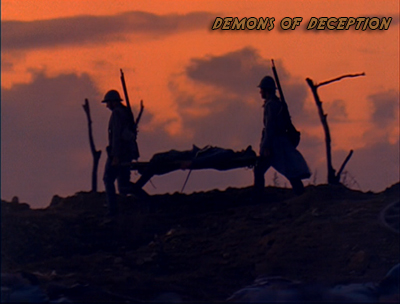
Indiana Jones finds deception on the front lines and in the bedroom dominating this sophisticated thought-provoking film. Indy addresses the moral ambiguities of leadership when confronted with win-at-any-cost military officials who have callous disregard for the lives of the men they command. The gut-wrenching horror of trench warfare, vividly depicted in harrowing battle scenes, is contrasted when Indy goes on leave in Paris and engages in a torrid affair with infamous spy Mata Hari. She shows him that love, like war, can also be fraught with deception, disillusionment and heartbreak.
Key Topics: | Battle of Verdun, Mata Hari, and espionage. |
Historic People: | Henri Philippe Petain—French general and later Premiere of France |
People and Topics
DescriptorThe German assault on the French town of Verdun was one of the toughest and bloodiest battles of WWI. France's leaders, desperate to split the powerful German army, devised a new battle plan that would evolve into the more deadly Battle of the Somme. BooksMartin, William. Verdun 1916: "They Shall Not Pass." Oxford: Osprey Publishing Ltd., 2001. Mason, David. Verdun. Gloucestershire:The Windrush Press, 2000. Ousby, Ian. The Road to Verdun: World War I's Most Momentous Battle and the Folly of Nationalism. New York:Doubleday, 2002. Websites |
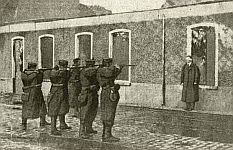
DescriptorDutch-born exotic dancer executed by the French for being a double-agent. Known for her close "connections" to high ranking officials on both sides of the war, it seemed possible that she was passing along important information. Mystery and conspiracy theories surround the story of Mata Hari to this day. BooksDarrow, Margaret H. French Women and the First World War. New York: Berg, 2000. Grayzel, Susan R. Women and the First World War. New York: Pearson Education Limited, 2002. Websites |
DescriptorPetain was a French general, commander, and hero of World War I. Serving in many capacities between wars, Petain's "fall from grace" began when he signed an armistice with Nazi Germany and gave up roughly three-fifths of France's territory in 1940. After the war Petain was sentenced to death for being a traitor, but his sentence was commuted to life imprisonment by Charles de Gaulle. BooksBruce, Robert B. Petain: Verdun to Vichy. Potomac Books, 2005. Atkin, Nicholas. Profiles in Power: Petain. New York: Longman, 1998. Websites |
DescriptorEspionage is the act of obtaining secret or confidential information without the originating party's permission or knowledge. At the beginning of World War I, espionage was a crude and often misunderstood resource. As the war progressed espionage grew to become a decisive and crafty part of warfare helping lead to the armistice in November, 1918 (i.e. Britain's deciphering of the Zimmermann Telegram). By the onset of the Cold War, espionage had come into its own and paved the way for the classic image of fictional, but sometimes very real, spies like James Bond. BooksMorton, James. Spies of the First World War: Under Cover for King and Kaiser. The National Archives, 2010. Owen, David. Hidden Secrets: The Complete History of Espionage and the Technology Used to Support It. Firefly Books, 2002. Bungert, Heike et al. Secret Intelligence in the Twentieth Century. Routledge, 2003. Websites |
Disclaimer: All resources (including books and websites) provided on indyintheclassroom.com are intended to be used by educators. Indyintheclassroom.com is not responsible for the content on linked websites.
Copyright: All images on Indyintheclassroom.com are used with permission or are in the public domain. Exceptions are noted. For additional information see our Copyright section. |
Documentary Previews
Below you will find information about each documentary that supplements Demons of Deception.
Into the Furnace: The Battle of Verdun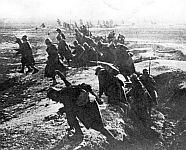 | They called Verdun the Meat Grinder. The Furnace. Hell. When the fighting died down, almost a year after it began, French and German armies were back where they started -- minus close to one million men. The Battle of Verdun came to symbolize the senseless slaughter of the First World War, but for the French, who won the war at enormous cost, it left a deeper and more personal mark. The soul of France was ripped out in the muddy trenches of Verdun. Produced and Written by Sharon Wood. Running Time: (0:28:45)
|
Marshal Petain's Fall from Grace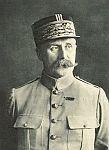 | In 1916, 60-year old General Henri Philippe Pétain, who'd been passed by for promotion most of his life, took charge of a horrific World War I battle that would mark France for generations. The Battle of Verdun, called the Meatgrinder, was the first in modern history where one army's goal was just to kill maximum numbers of the enemy. Amidst this death and destruction, Pétain came to life. Thirty years later, Pétain would go on trail, accused of treason at age 89. He had saved France once, on a First World War battlefield. But when his countrymen turned to him to save them again, as head of government during World War II, he failed spectacularly. Produced and Written by Sharon Wood. Running Time: (0:30:41)
|
Flirting with Danger: The Fantasy of Mata Hari | A palpable tension held its grip on Paris in 1917. It was the third disastrous year of World War I. France was losing badly -- and looking for someone to blame. In mid-February, word spread through the city that one of the most famous women in Europe had been arrested and accused of spying for Germany -- France's enemy in the war. Her name was Mata Hari. Produced and Written by Jennifer Petrucelli. Running Time: (0:29:53)
|
Reading the Enemy's Mind: Espionage in World War I | Over the course of the 20th century, the secretive government agencies and the spies who ran them would complete the transformation of espionage from an amateur activity to a full-time profession. Nations have come to rely on spies for protection from terrorists, other spies, and attacks by enemies. Secrecy keeps their activities out of sight until a rogue agent is caught using espionage for treasonous or greedy ends, or when their efforts to protect us fail. But as spy-tools grow more and more sophisticated, one thing is certain: espionage is here to stay. Produced and Written by Mark Page. Running Time: (0:24:21)
|
Disclaimer: All resources (including books and websites) provided on indyintheclassroom.com are intended to be used by educators. Indyintheclassroom.com is not responsible for the content on linked websites.
Copyright: All images on Indyintheclassroom.com are used with permission or are in the public domain. Exceptions are noted. For additional information see our Copyright section. |
Indy Connections: Demons of Deception
Below are current event articles that relate to events, topics, and people found in Demons of Deception.
The Most Loved and Hated Novel About World War I
Smithsonian.com
6/16/2015
On December 5, 1930, just over 12 years after the end of World War I, German moviegoers flocked to Berlin’s Mozart Hall to see one of Hollywood’s latest films. But during the movie, a cadre of 150 Nazi Brownshirts, nearly all too young to have fought in World War I, were led into the theater by propagandist Joseph Goebbels. Spewing anti-Semitic invective at the screen, they repeatedly shouted “Judenfilm!” as they tossed stink bombs from the balcony, threw sneezing powder in the air, and released white mice into the theater. A somewhat shocking turn of events, considering the movie was the highly anticipated adaptation of countryman Erich Maria Remarque’s novel All Quiet on the Western Front, the blockbuster novel that had transfixed the nation months earlier.
Sunken Wrecks Of Epic WWI Naval Battle Revealed
news.sky.com
6/16/2015
They show the battered wrecks of several of the 25 warships - 14 of them British - that were blown up during the Battle of Jutland on 31 May, 1916. Among them is HMS Invincible which was torn apart by a German shell, killing more than 1,000 sailors. HMS Defence and HMS Queen Mary were also scanned during the survey.
World War One time capsule discovered in Germany
telegraph.co.uk
11/21/2014
A hundred years after the outbreak of the First World War, builders renovating a historic castle in Germany’s Ruhr valley have found a time capsule that appears to have been left in memory of soldiers who died in the conflict.
WWI Canadian soldiers' remains identified
cbc.ca
10/5/2014
Nearly a century after they died in battle, the remains of unidentified Canadian soldiers who fought in the First World War are still being found in Europe.
Today the Department of National Defence released the names of four who died during the Battle of Amiens in August 1918.
Their resting place was discovered in 2006 by then 14-year-old Fabien Demeusere, while digging in his back garden in Hallu, France, 120 kilometres north of Paris.
Trench Warfare in World War I Was a Smarter Strategy Than You Realize
io9.com
9/22/2014
History remembers trench warfare as wasteful, futile, and uninspired, but in reality it was a deeply thought-out system that underwent constant revision. Here's how it worked during World War I.
Top image: A painting by Captain Kenneth Keith Forbes shows a Canadian 6-inch howitzer supporting British troops in the attack on Thiepval on 16 July 1916 during the Somme offensive. Via Canadian Artillery in Action.
It was around this time 100 years ago that the mobile battlefield along the Western Front ground to a screeching halt — a 440 mile stretch that barely moved in the ensuing four years.
The Legend of What Actually Lived in the "No Man's Land" Between World War I's Trenches
Smithsonian.com
9/8/2014
During World War I, No Man’s Land was both an actual and a metaphorical space. It separated the front lines of the opposing armies and was perhaps the only location where enemy troops could meet without hostility. It was in No Man's Land that the spontaneous Christmas truce of December 1914 took place and where opposing troops might unofficially agree to safely remove their wounded comrades, or even sunbathe on the first days of spring.
First World War: how Telegraph readers saw it
telegraph.co.uk
9/2/2014
Everyone knows about the horrors of life in the trenches of the First World War, but it’s only recently that the anxieties of people back home in Britain have started to be talked about.
At long last, those feelings are being aired more widely, thanks to a new anthology of letters written, at the time, to The Daily Telegraph. The message these missives impart is of a nation that was desperate to provide support, of any kind, to our brave boys fighting on just the other side of the Channel.
The Blockbuster World War I Film that Brought Home the Traumatic Impact of War
Smithsonian.com
8/21/2014
The United States had entered the war with high hopes and dreams—aiming to make the world “safe for democracy” as President Woodrow Wilson would proclaim, but by the 1920s there were strong feelings that the U.S. should never have gotten itself involved in the byzantine affairs of the European powers. Isolationist sentiments grew across the country especially after the rejection of the Versailles Treaty by the U.S. Congress in 1920. These feelings of bitterness and disappointment found their fullest expression in the literature of the day, written by members of what has become known as the “Lost Generation,” most notably John Dos Passos, William Faulkner, F. Scott Fitzgerald and Ernest Hemingway.
First World War centenary: how the events of August 2 1914 unfolded
telegraph.co.uk
8/2/2014
Britain went to war on August 4 1914. In the second part of a four-day series, we document the dramatic events leading up to the declaration of war as they happened, hour-by-hour.
So Today I Learned that France built a Replica of Paris in WWI
messynessychic.com
6/11/2014
In Paris, every first Wednesday of the month at noon, without fail you can hear the eerie wail of an air raid siren from wherever you are in the city. They’ve been going since pre-World War II and have these monthly tests to make sure everything is in working order– or to serve as a spooky reminder of what life was like during wartime (that’s the theory I’m going with anyway).
Disclaimer: All resources (including books and websites) provided on indyintheclassroom.com are intended to be used by educators. Indyintheclassroom.com is not responsible for the content on linked websites.
Copyright: All images on Indyintheclassroom.com are used with permission or are in the public domain. Exceptions are noted. For additional information see our Copyright section. |

Trenches of Hell | Demons of Deception | Phantom Train of Doom
Young Indy Home
Proud Supporters of |
 |
 |
Copyright © 2007- IndyintheClassroom.com
Send questions & comments toWebmasterThis website is owned and operated by EDventure Quest Learning LLC. It is not hosted, operated, endorsed, sponsored by, or affiliated with, Lucasfilm, Ltd., Paramount Pictures, or CBS or any of their affiliates. Indiana Jones and all related indicia are TM & © Lucasfilm Ltd. All rights reserved. COURTESY OF LUCASFILM LTD. |
Disclaimer | Site Map | Search