Espionage Escapades | Daredevils of the Desert | Tales of Innocence
Young Indy Home
Chapter Overview
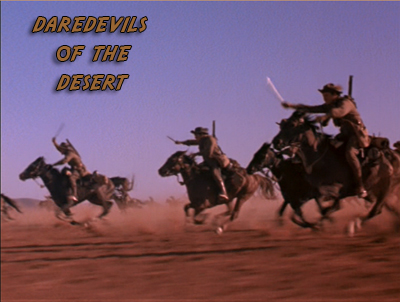
Under orders from the French, but working with the British, Indy teams up with old friend, T.E. Lawrence to assist in the allied plan to conquer Jerusalem by Christmas. He is ordered to sneak into the ancient town of Beersheba and protect the city's water supply that would certainly be destroyed by the occupying Germans at the first sign of defeat. Indy poses as a trader and teams up with a beautiful female spy to infiltrate the ancient town. The plan takes an unexpected turn when Indy and his companion are captured just before the allied attack is launched. The action reaches new heights as soldiers of the Australian Lighthorse lead a brave and magnificent cavalry charge on the town.
Key Topics: | World War I in the Middle East; Australian Lighthorse |
Historic People: | T.E. Lawrence-- scholar, archaeologist, diplomat and British military hero |
People and Topics
DescriptorScholar, archaeologist, diplomat and British military hero whose famous exploits forever made him Lawrence of Arabia. Beginning in 1911, Lawrence studied Arabic and archaeology in the Middle East. When war broke out, his knowledge of Arabic and Middle Eastern geography made him an invaluable part of the British Army. The relationships he forged earlier allowed him to serve as a trusted diplomat to Arabs during and after the war. Exclusive Documentary PreviewBooksLawrence, T.E. Seven Pillars of Wisdom: A Triumph. London: Jonathan Cape Publishers, 1936. Wilson, Jeremy. Lawrence of Arabia, The Authorised Biography. London: Heinemann, 1989. Websites |
DescriptorOften falling in the shadow of the Western Front, WWI in the Middle East was every bit as harsh and unforgiving as the fighting in the rest of the world. The fall of the Ottoman Empire at the end of WWI began the turmoil and confusion that still rocks the Middle East to this day. Exclusive Documentary PreviewBooksFromkin, David. A Peace to End All Peace. New York: Henry Holt & Co., 1989. Gelvin, James L. The Modern Middle East: A History. Oxford: Oxford University Press, 2005. Websites |
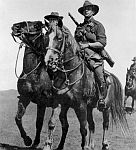
DescriptorName for the Australian cavalry and mounted infantry. The Australian 4th Light Horse Brigade are credited with the last successful cavalry charge in history (Battle of Beersheba in 1917... shown in this episode). The ALH are also known for wearing Ostrich plumes in their hats. BooksJones, Ian. The Australian Light Horse: Australians at War. United Kingdom: Time Life Books, 1987. Hollis, Kenneth. Thunder of the Hooves: A History of 12 Australian Light Horse Regiments 1915-1919. Australian Military History Publications, 2008. WebsitesAustralian Lighthorse Association |
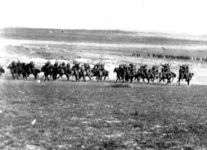
DescriptorPart of the larger Sinai and Palestine Campaign, the Allies made a bold move of crossing the desert without adequate water supplies in hopes of securing Beersheba and avoiding the stronger defenses at Gaza. In the end, the bold plan proved successful due to the 4th Lighthorse Brigade who led history's last successful cavalry charge. BooksGrainger, John D. The Battle for Palestine, 1917. Woodbridge: Boydell Press, 2006. Jones, Ian. The Australian Light Horse: Australians at War. United Kingdom: Time Life Books, 1987. Hollis, Kenneth. Thunder of the Hooves: A History of 12 Australian Light Horse Regiments 1915-1919. Australian Military History Publications, 2008. WebsitesAustralian Lighthorse Association- Battle at Beersheba |
Disclaimer: All resources (including books and websites) provided on indyintheclassroom.com are intended to be used by educators. Indyintheclassroom.com is not responsible for the content on linked websites.
Copyright: All images on Indyintheclassroom.com are used with permission or are in the public domain. Exceptions are noted. For additional information see our Copyright section. |
Documentary Previews
Below you will find information about each documentary that supplements Daredevils of the Desert.
Lines in the Sand: The Middle East and the Great War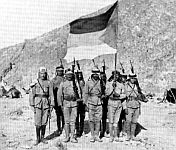 | The Ottoman Empire once spanned three continents, stretching from Budapest to Basra to Algiers. Founded around 1300 , it created a rich, multi-ethnic world that was Islamic in faith and tolerant in practice. But by the early 20th century, the Empire was under attack from without and challenged from within. When World War broke out in 1914, the Ottomans had to choose sides. They cast their lot with Germany and Austria, and against Britain, France, and Russia. That decision would lead to the Empire's final destruction -- and the creation of the modern Middle East. Produced and written by Sharon Wood. Running Time: (0:34:29)
|
Colonel Lawrence's War: T.E. Lawrence and Arabia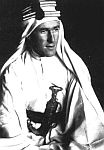 | He was an action hero as well as an intellectual hero. T.E. Lawrence escaped a safe office job during World War I to become a guerilla war mastermind in desert combat, fighting alongside Arabs to throw off the rule of the Ottoman Empire. But despite British promises of Arab independence, the Middle East would end up being carved by European colonial treaties, and Lawrence faced the challenges of keeping his word to his trusted compatriots of the desert. Produced and written by Sharon Wood.. Running Time: (0:36:05) This documentary is also available with the bonus features for Chapter 1: My First Adventure |
Disclaimer: All resources (including books and websites) provided on indyintheclassroom.com are intended to be used by educators. Indyintheclassroom.com is not responsible for the content on linked websites.
Copyright: All images on Indyintheclassroom.com are used with permission or are in the public domain. Exceptions are noted. For additional information see our Copyright section. |
Indy Connections: Daredevils of the Desert
Below are current event articles that relate to events, topics, and people found in Daredevils of the Desert.
The Most Loved and Hated Novel About World War I
Smithsonian.com
6/16/2015
On December 5, 1930, just over 12 years after the end of World War I, German moviegoers flocked to Berlin’s Mozart Hall to see one of Hollywood’s latest films. But during the movie, a cadre of 150 Nazi Brownshirts, nearly all too young to have fought in World War I, were led into the theater by propagandist Joseph Goebbels. Spewing anti-Semitic invective at the screen, they repeatedly shouted “Judenfilm!” as they tossed stink bombs from the balcony, threw sneezing powder in the air, and released white mice into the theater. A somewhat shocking turn of events, considering the movie was the highly anticipated adaptation of countryman Erich Maria Remarque’s novel All Quiet on the Western Front, the blockbuster novel that had transfixed the nation months earlier.
Sunken Wrecks Of Epic WWI Naval Battle Revealed
news.sky.com
6/16/2015
They show the battered wrecks of several of the 25 warships - 14 of them British - that were blown up during the Battle of Jutland on 31 May, 1916. Among them is HMS Invincible which was torn apart by a German shell, killing more than 1,000 sailors. HMS Defence and HMS Queen Mary were also scanned during the survey.
A New View of the Battle of Gallipoli, One of the Bloodiest Conflicts of World War I
Smithsonian.com
2/1/2015
Thirty-two cutters filled with British troops advanced steadily across the sea under a brightening sky. The men clutched their rifles and peered at a crescent of sand a few hundred yards away, fortified by barbed wire strung across wooden posts. Just beyond the beach rose rugged limestone cliffs covered in heavy brush. It was a few minutes after dawn on April 25, 1915, and the 1st Battalion of the Lancashire Fusiliers was preparing to land on W Beach on the southern end of the Gallipoli Peninsula. “It might have been a deserted land we were nearing in our little boats,” remembered Capt. Richard Willis, commander of C Company. “Then, crack!"
World War One time capsule discovered in Germany
telegraph.co.uk
11/21/2014
A hundred years after the outbreak of the First World War, builders renovating a historic castle in Germany’s Ruhr valley have found a time capsule that appears to have been left in memory of soldiers who died in the conflict.
WWI Canadian soldiers' remains identified
cbc.ca
10/5/2014
Nearly a century after they died in battle, the remains of unidentified Canadian soldiers who fought in the First World War are still being found in Europe.
Today the Department of National Defence released the names of four who died during the Battle of Amiens in August 1918.
Their resting place was discovered in 2006 by then 14-year-old Fabien Demeusere, while digging in his back garden in Hallu, France, 120 kilometres north of Paris.
Trench Warfare in World War I Was a Smarter Strategy Than You Realize
io9.com
9/22/2014
History remembers trench warfare as wasteful, futile, and uninspired, but in reality it was a deeply thought-out system that underwent constant revision. Here's how it worked during World War I.
Top image: A painting by Captain Kenneth Keith Forbes shows a Canadian 6-inch howitzer supporting British troops in the attack on Thiepval on 16 July 1916 during the Somme offensive. Via Canadian Artillery in Action.
It was around this time 100 years ago that the mobile battlefield along the Western Front ground to a screeching halt — a 440 mile stretch that barely moved in the ensuing four years.
What New Zealanders left behind in Arras, France
ww100.govt.nz
9/22/2014
Between 1916 and 1917, the New Zealand Tunnelling Company linked a subterranean system of quarries beneath the Western Front, and named them after New Zealand places to help themselves stay oriented underground.
Originally mined for chalk to build the French town of Arras, the vast network of 200 year-old underground quarries was rediscovered in September 1916. The New Zealand tunnellers were tasked with linking and extending these old quarries in preparation for a major Allied attack on the Germans. Once complete, the quarried spaces would secretly house Allied troops before they took on the enemy in the ‘Battle of Arras’.
The Legend of What Actually Lived in the "No Man's Land" Between World War I's Trenches
Smithsonian.com
9/8/2014
During World War I, No Man’s Land was both an actual and a metaphorical space. It separated the front lines of the opposing armies and was perhaps the only location where enemy troops could meet without hostility. It was in No Man's Land that the spontaneous Christmas truce of December 1914 took place and where opposing troops might unofficially agree to safely remove their wounded comrades, or even sunbathe on the first days of spring.
First World War: how Telegraph readers saw it
telegraph.co.uk
9/2/2014
Everyone knows about the horrors of life in the trenches of the First World War, but it’s only recently that the anxieties of people back home in Britain have started to be talked about.
At long last, those feelings are being aired more widely, thanks to a new anthology of letters written, at the time, to The Daily Telegraph. The message these missives impart is of a nation that was desperate to provide support, of any kind, to our brave boys fighting on just the other side of the Channel.
The Blockbuster World War I Film that Brought Home the Traumatic Impact of War
Smithsonian.com
8/21/2014
The United States had entered the war with high hopes and dreams—aiming to make the world “safe for democracy” as President Woodrow Wilson would proclaim, but by the 1920s there were strong feelings that the U.S. should never have gotten itself involved in the byzantine affairs of the European powers. Isolationist sentiments grew across the country especially after the rejection of the Versailles Treaty by the U.S. Congress in 1920. These feelings of bitterness and disappointment found their fullest expression in the literature of the day, written by members of what has become known as the “Lost Generation,” most notably John Dos Passos, William Faulkner, F. Scott Fitzgerald and Ernest Hemingway.
Disclaimer: All resources (including books and websites) provided on indyintheclassroom.com are intended to be used by educators. Indyintheclassroom.com is not responsible for the content on linked websites.
Copyright: All images on Indyintheclassroom.com are used with permission or are in the public domain. Exceptions are noted. For additional information see our Copyright section. |

Espionage Escapades | Daredevils of the Desert | Tales of Innocence
Young Indy Home
Proud Supporters of |
 |
 |
Copyright © 2007- IndyintheClassroom.com
Send questions & comments toWebmasterThis website is owned and operated by EDventure Quest Learning LLC. It is not hosted, operated, endorsed, sponsored by, or affiliated with, Lucasfilm, Ltd., Paramount Pictures, or CBS or any of their affiliates. Indiana Jones and all related indicia are TM & © Lucasfilm Ltd. All rights reserved. COURTESY OF LUCASFILM LTD. |
Disclaimer | Site Map | Search