Masks of Evil | Treasure of the Peacock's Eye | Winds of Change
Young Indy Home
Chapter Overview
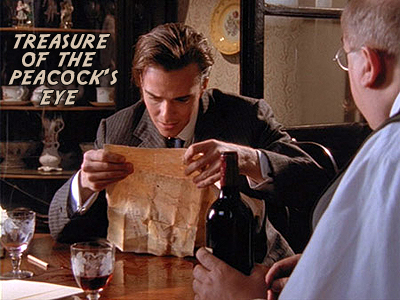
As World War I winds down, Indy teams up with his old friend Remy to track down a saboteur in the trenches. When the traitor is finally discovered, his dying words and a map send Indy and Remy around the world to find the Treasure of the Peacock’s Eye. Along the way Indy meets up with his old friend Howard Carter who is travelling with E.M. Forster. Following a dangerous trail that leads them from London to Alexandria and finally to the South China Seas, Indy finds himself making a life altering decision that will eventually lead him back home to America. One-eyed Germans, headhunting natives, and Chinese pirates make this exciting quest a foreshadowing of the Indiana Jones that will mature into the whip-cracking adventurer that we all love.
Key Topics: | Alexander the Great; Bronislaw Malinowski; Anthropology |
Historic People: | Bronislaw Malinowski—Famed Anthropologist who studied in Papua New Guinea & the Trobriand Islands. |
People and Topics
DescriptorFamed Anthropologist who studied in Papua New Guinea & the Trobriand Islands. BooksMalinowski, Bronislaw. A Diary in the Strict Sense of the Term. New York: Harcourt, Brace & World, Inc., 1967. Young, Michael W. Malinowski: Odyssey of an Anthropologist. New Haven and London: Yale University Press, 2004. Websites |
DescriptorIs quite simply defined as the study of humanity. Anthropology examines culture, how and why people behave the way they do, how people interact, etc. Anthropologists are known for immersing themselves in a culture by "moving in" with the group being studied. BooksErikson, Thomas Hylland, Finn Sivert Nielsen. A History of Anthropology. London: Pluto Press, 2001. Erikson, Thomas Hylland. What is Anthropology. London: Pluto Press, 2004. WebsitesAmerican Anthropological Association Smithsonian Department of Anthropology |
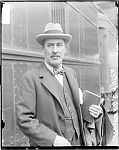
DescriptorArchaeologist who discovered the tomb of King Tutankhamun and ushered in a new era of archaeology with his dedication to conservation and study of finds. BooksReeves, Nicholas, John H. Taylor. Howard Carter Before Tutankhamun. New York: Harry M. Abrams, 1992. Hoving, Thomas. Tutankhamun: The Untold Story. New York: Simon & Schuster, 1978. Websites |
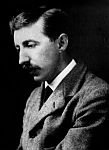
DescriptorBritish writer of such novels as A Passage to India & Howards End. BooksForster, E.M. A Passage to India. Penguin Books Ltd., 2000. Furbank, P.N. E.M. Forster: A Life. Harvest Books, 1994. Websites |
Disclaimer: All resources (including books and websites) provided on indyintheclassroom.com are intended to be used by educators. Indyintheclassroom.com is not responsible for the content on linked websites.
Copyright: All images on Indyintheclassroom.com are used with permission or are in the public domain. Exceptions are noted. For additional information see our Copyright section. |
Documentary Previews
Below you will find information about each documentary that supplements Treasure of the Peacock's Eye.
Bronislaw Malinowski: God Professor | In 1915, a Polish scholar named Bronislaw Malinowski landed on a tiny island off the coast of New Guinea. He had come as an anthropologist -- a scientist who studies the origins and behavior of human kind. He had come to investigate the lifestyle, customs and beliefs of the people who lived there. The methods he would develop to conduct his investigation would change anthropology forever. Produced by Mark Page and Jennifer Petrucelli; Written by Mark Page. Running Time: (0:29:34) |
Anthropology: Looking at the Human Condition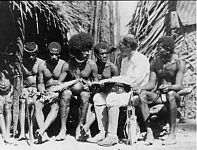 | For over 100 years anthropologists have been learning from people in every corner of our world, and using the data they gather to create a group portrait of the human race. And wherever they find their subjects -- whether they live on the other side of the globe or just down the block, hang out in a tropical rainforest, a corporate boardroom or a parking lot, anthropologists help us to understand our fellow human beings, and our selves. Produced by Mark Page and Jennifer Petrucelli; Written by Mark Page. Running Time: (0:23:48) |
New Guinea: Paradise in Peril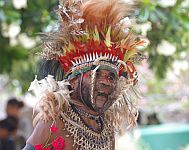 | A land of mystery and danger, it's been said that New Guinea contains more strange and new and beautiful things than any other part of the globe. Located off the coast of southeast Asia just North of Australia, this rugged and vast tropical island was one of the last places on Earth to be explored by white men. Tantalizing glimpses of the fierce people who lived in New Guinea as well as the island's stunning plant and animal life have long lured Western adventurers looking to make new discoveries. They were not disappointed. Produced and Written by Betsy Bayha. Running Time: (0:25:04) |
Disclaimer: All resources (including books and websites) provided on indyintheclassroom.com are intended to be used by educators. Indyintheclassroom.com is not responsible for the content on linked websites.
Copyright: All images on Indyintheclassroom.com are used with permission or are in the public domain. Exceptions are noted. For additional information see our Copyright section. |
Indy Connections: Treasure of the Peacock's Eye
Below are current event articles that relate to events, topics, and people found in Treasure of the Peacock's Eye.
The Lost City of Cambodia
Smithsonian.com
4/1/2016
Jean-Baptiste Chevance senses that we’re closing in on our target. Paused in a jungle clearing in northwestern Cambodia, the French archaeologist studies his GPS and mops the sweat from his forehead with a bandanna. The temperature is pushing 95, and the equatorial sun beats down through the forest canopy. For two hours, Chevance, known to everyone as JB, has been leading me, along with a two-man Cambodian research team, on a grueling trek. We’ve ripped our arms and faces on six-foot shrubs studded with thorns, been savaged by red biting ants, and stumbled over vines that stretch at ankle height across the forest floor. Chevance checks the coordinates. “You can see that the vegetation here is very green, and the plants are different from the ones we have seen,” he says. “That’s an indication of a permanent water source.”
Sunken Wrecks Of Epic WWI Naval Battle Revealed
news.sky.com
6/16/2015
They show the battered wrecks of several of the 25 warships - 14 of them British - that were blown up during the Battle of Jutland on 31 May, 1916. Among them is HMS Invincible which was torn apart by a German shell, killing more than 1,000 sailors. HMS Defence and HMS Queen Mary were also scanned during the survey.
The Most Loved and Hated Novel About World War I
Smithsonian.com
6/16/2015
On December 5, 1930, just over 12 years after the end of World War I, German moviegoers flocked to Berlin’s Mozart Hall to see one of Hollywood’s latest films. But during the movie, a cadre of 150 Nazi Brownshirts, nearly all too young to have fought in World War I, were led into the theater by propagandist Joseph Goebbels. Spewing anti-Semitic invective at the screen, they repeatedly shouted “Judenfilm!” as they tossed stink bombs from the balcony, threw sneezing powder in the air, and released white mice into the theater. A somewhat shocking turn of events, considering the movie was the highly anticipated adaptation of countryman Erich Maria Remarque’s novel All Quiet on the Western Front, the blockbuster novel that had transfixed the nation months earlier.
Finding This Lost City in Honduras Was the Easy Part
nytimes.com
3/20/2015
RIGHT now, in the jungle some 50 miles inland from the Mosquito Coast of Honduras, sits an astounding cache of ancient artifacts, until this month most likely unseen by human eyes for somewhere between 600 and 1,000 years. I traveled there three weeks ago with a team of archaeologists, anthropologists, ethnobotanists, filmmakers and Honduran soldiers, who were following up on lidar images — a laser-based aerial surveillance technology — that suggested the presence of ruins.
Spanish Conquest of the Incas Caused Air Pollution to Spike
Smithsonian.com
2/9/2015
The arrival of the Spanish in South America in the late 16th century heralded the destruction of the once mighty Inca empire—and triggered a surge in air pollution levels that was not exceeded until the 20th century.
Amazon Warriors Did Indeed Fight and Die Like Men
Nationalgeographic.com
10/29/2014
The Amazons got a bum rap in antiquity. They wore trousers. They smoked pot, covered their skin with tattoos, rode horses, and fought as hard as the guys. Legends sprang up like weeds. They cut off their breasts to fire their bows better! They mutilated or killed their boy children! Modern (mostly male) scholars continued the confabulations. The Amazons were hard-core feminists. Man haters. Delinquent mothers. Lesbians.
WWI Canadian soldiers' remains identified
cbc.ca
10/5/2014
Nearly a century after they died in battle, the remains of unidentified Canadian soldiers who fought in the First World War are still being found in Europe.
Today the Department of National Defence released the names of four who died during the Battle of Amiens in August 1918.
Their resting place was discovered in 2006 by then 14-year-old Fabien Demeusere, while digging in his back garden in Hallu, France, 120 kilometres north of Paris.
Trench Warfare in World War I Was a Smarter Strategy Than You Realize
io9.com
9/22/2014
History remembers trench warfare as wasteful, futile, and uninspired, but in reality it was a deeply thought-out system that underwent constant revision. Here's how it worked during World War I.
Top image: A painting by Captain Kenneth Keith Forbes shows a Canadian 6-inch howitzer supporting British troops in the attack on Thiepval on 16 July 1916 during the Somme offensive. Via Canadian Artillery in Action.
It was around this time 100 years ago that the mobile battlefield along the Western Front ground to a screeching halt — a 440 mile stretch that barely moved in the ensuing four years.
The Legend of What Actually Lived in the "No Man's Land" Between World War I's Trenches
Smithsonian.com
9/8/2014
During World War I, No Man’s Land was both an actual and a metaphorical space. It separated the front lines of the opposing armies and was perhaps the only location where enemy troops could meet without hostility. It was in No Man's Land that the spontaneous Christmas truce of December 1914 took place and where opposing troops might unofficially agree to safely remove their wounded comrades, or even sunbathe on the first days of spring.
The Blockbuster World War I Film that Brought Home the Traumatic Impact of War
Smithsonian.com
8/21/2014
The United States had entered the war with high hopes and dreams—aiming to make the world “safe for democracy” as President Woodrow Wilson would proclaim, but by the 1920s there were strong feelings that the U.S. should never have gotten itself involved in the byzantine affairs of the European powers. Isolationist sentiments grew across the country especially after the rejection of the Versailles Treaty by the U.S. Congress in 1920. These feelings of bitterness and disappointment found their fullest expression in the literature of the day, written by members of what has become known as the “Lost Generation,” most notably John Dos Passos, William Faulkner, F. Scott Fitzgerald and Ernest Hemingway.
Disclaimer: All resources (including books and websites) provided on indyintheclassroom.com are intended to be used by educators. Indyintheclassroom.com is not responsible for the content on linked websites.
Copyright: All images on Indyintheclassroom.com are used with permission or are in the public domain. Exceptions are noted. For additional information see our Copyright section. |

Masks of Evil | Treasure of the Peacock's Eye | Winds of Change
Young Indy Home
Proud Supporters of |
 |
 |
Copyright © 2007- IndyintheClassroom.com
Send questions & comments toWebmasterThis website is owned and operated by EDventure Quest Learning LLC. It is not hosted, operated, endorsed, sponsored by, or affiliated with, Lucasfilm, Ltd., Paramount Pictures, or CBS or any of their affiliates. Indiana Jones and all related indicia are TM & © Lucasfilm Ltd. All rights reserved. COURTESY OF LUCASFILM LTD. |
Disclaimer | Site Map | Search