Oganga | Attack of the Hawkmen | Adventures in the Secret Service
Young Indy Home
Chapter Overview
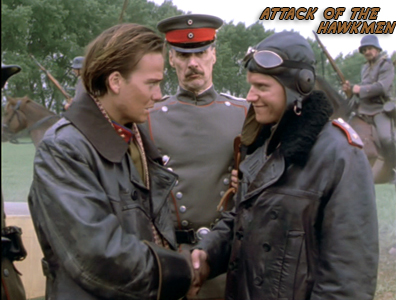
Indy takes to the skies in this highflying thriller. The French Secret Service dispatches Indy to the Lafayette Escadrille to aid the allies in aerial reconnaissance of the German lines. Danger lurks as Indy faces off with the legendary ace of aces Manfred von Richthofen, known more commonly as the Red Baron. Indy’s secret mission then takes him behind enemy lines to lure aircraft designer, Anthony Fokker, into defection to the allies. This dangerous mission becomes all the more important when Indy discovers a powerful secret weapon that Fokker has designed for the Germans.
Key Topics: | War in the third dimension; Lafayette Escadrille; Espionage |
Historic People: | Manfred von Richthofen-- German fighter pilot who became the top Ace of World War I (80 kills). Earned nickname, The Red Baron. |
People and Topics
DescriptorWorld War I was the first war to feature aerial combat. Planes, zeppelins, and strategic bombing were all used for the first time. BooksMorrow, John H. Jr. The Great War in the Air. Washington and London: Smithsonian Institution Press, 1993. Frandsen, Bert. Hat in the Ring. Washington and London: Smithsonian Books, 2003. WebsitesThe Aerodrome: Aces and Aircraft of WWI |
DescriptorA French air squadron of mostly American volunteer pilots who sought adventure in the Great War long before their country did. BooksGordon, Dennis. The Lafayette Flying Corps: The American Volunteers in the French Air Service in the World War One. Atglen, PA: Schiffer Publishing Ltd., 2000. Parsons, E.C. The Great Adventure: The Story of the Lafayette Escadrille. Garden City, NY: Doubleday, Doran & Company, Inc, 1937. Websites |
DescriptorOriginally a cavalry officer, Baron von Richthofen grew bored with the fighting on the Western Front and began looking to the skies. It's surprising to learn that the "Red Baron," as he became known, had to take flying lessons just like any other pilot. However, his natural ability and ambition drove him to become the top ace of World War I (80 kills). A legend in his own time, the "Red Baron" remains to this day the quintessential fighter pilot. BooksVon Richthofen, Manfred. Der Rote Kampfflieger, or the Red Battle Flier. Franks, Giblin and McCrery. Under the Guns of the Red Baron: The Complete Record of von Richthofen's Victories and Victims Fully Illustrated. Websites |
DescriptorDutch born aircraft engineer who designed some of the best known planes of WWI, including the Red Baron's infamous Fokker Dr.I triplane. He is also known for developing the synchronization gear that allowed pilots to fire straight ahead through their propellor. Fokker was "employed" by Germany (Central Powers) throughout the war. After WWI, he turned to making civilian aircraft. BooksDierikx, Marc. Fokker: A Transatlantic Biography. US: The Smithsonian Institution, 1997. Postma, Thijs. Fokker: Aircraft Builders to the World. New York: Jane's Incorporated, 1980. Websites |
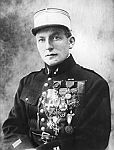
DescriptorFlamboyant and sometimes reckless French Ace pilot who fought in WWI. Died in 1927 attempting to be the first to make the transatlantic flight (Paris to New York). BooksFranks, Norman, Frank W. Bailey. Over the Front: A Complete Record of the Fighter Aces and Units of the U.S. and French Air Services 1914-1918. Grub Street, London, 1922. Websites |
Disclaimer: All resources (including books and websites) provided on indyintheclassroom.com are intended to be used by educators. Indyintheclassroom.com is not responsible for the content on linked websites.
Copyright: All images on Indyintheclassroom.com are used with permission or are in the public domain. Exceptions are noted. For additional information see our Copyright section. |
Documentary Previews
Below you will find information about each documentary that supplements Attack of the Hawkmen.
War in the Third Dimension: Aerial Warfare in World War I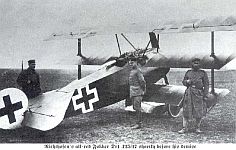 | When World War I began, the rival armies charged into battle with frightening new weapons that seemed ready to change the very nature of war. One promising new piece of military hardware -- the airplane -- wasn't quite ready to hit its mark. That didn't stop a few passionate advocates from making big plans for airplanes, or from dreaming up ways to use them in war. By the end of the war these visionaries would transform the flimsy airplanes of 1914 into powerful and dependable weapons, and take war where it had rarely gone before: beyond the two dimensional realm of our planet's surface, into the third dimension of the air above. Produced by Mark Page and Jennifer Petrucelli. Written by Mark Page. Running Time: (0:27:34) |
Blood Red: The Life and Death of Manfred von Richthofen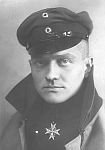 | Today, historians and aviation buffs still celebrate the Red Baron as the ideal fighter pilot. A daring knight of the sky who helped write the book on aerial combat during the world's first air war. For the man behind the myth, however, the real story is a tale of disillusionment; a blood red saga in which ancient ideals of chivalry, honor and duty came crashing down in the fires of modern war. Produced and written by Mark Page and Jennifer Petrucell. Written by Mark Page. Running Time: (0:27:43) |
Flying High for France: The Lafayette Escadrille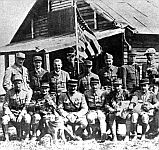 | In a war that claimed millions of lives, most who served in the military fought because they had no choice. But the high flying men of the Lafayette Escadrille were different: they didn't have to be there. They were American adventurers who volunteered for World War One long before their country joined. They were lawyers, authors, heirs to banking and railroad fortunes, Ivy League graduates, friends of royalty, sons of privilege. All they wanted was a chance to fly. The young pilots came to the war with romantic ideas of adventure and heroism. They had no idea what they were in for. Produced and written by Karena O'Riordan. Running Time: (0:26:13) |
Anthony Fokker: The Flying Dutchman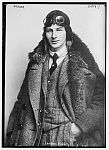 | On November 11, 1918, the Germans laid down their arms, finally ending World War I. In the surrender agreement, the Allies listed the numbers of cannons, machine guns and other weapons that Germany had to turn over. Yet of 1,700 airplanes demanded, only one type was so feared that it was mentioned by name: the D-7. The deadly machine was the masterwork of a 28 year-old Dutchman who had become Germany's most skilled -- and unconventional -- plane maker: Anthony Fokker. Produced and written by Mike Welt. Running Time: (0:27:31) |
Disclaimer: All resources (including books and websites) provided on indyintheclassroom.com are intended to be used by educators. Indyintheclassroom.com is not responsible for the content on linked websites.
Copyright: All images on Indyintheclassroom.com are used with permission or are in the public domain. Exceptions are noted. For additional information see our Copyright section. |
Indy Connections: Attack of the Hawkmen
Below are current event articles that relate to events, topics, and people found in Attack of the Hawkmen.
The Most Loved and Hated Novel About World War I
Smithsonian.com
6/16/2015
On December 5, 1930, just over 12 years after the end of World War I, German moviegoers flocked to Berlin’s Mozart Hall to see one of Hollywood’s latest films. But during the movie, a cadre of 150 Nazi Brownshirts, nearly all too young to have fought in World War I, were led into the theater by propagandist Joseph Goebbels. Spewing anti-Semitic invective at the screen, they repeatedly shouted “Judenfilm!” as they tossed stink bombs from the balcony, threw sneezing powder in the air, and released white mice into the theater. A somewhat shocking turn of events, considering the movie was the highly anticipated adaptation of countryman Erich Maria Remarque’s novel All Quiet on the Western Front, the blockbuster novel that had transfixed the nation months earlier.
Sunken Wrecks Of Epic WWI Naval Battle Revealed
news.sky.com
6/16/2015
They show the battered wrecks of several of the 25 warships - 14 of them British - that were blown up during the Battle of Jutland on 31 May, 1916. Among them is HMS Invincible which was torn apart by a German shell, killing more than 1,000 sailors. HMS Defence and HMS Queen Mary were also scanned during the survey.
Will the Search for Amelia Earhart Ever End?
Smithsonian.com
1/1/2015
Do you want to see it?” Ric Gillespie asks, reaching for a black portfolio resting on the floor of his Pennsylvania farmhouse. He extracts a sheet of aluminum, about 18 by 24 inches—bent, dented, scratched and crisscrossed by 103 rivet holes, whose size, position and spacing he has studied for almost 25 years the way assassination buffs pore over the Zapruder film. And with good reason: If he’s right, this is one of the great historical artifacts of the 20th century, a piece of the airplane in which Amelia Earhart made her famous last flight over the Pacific Ocean in July 1937.
Chocks away! British and German fighter planes from the First World War unveiled as part of new RAF Museum display
dailymail.co.uk
11/27/2014
The Royal Air Force Museum is set to open a new permanent exhibition to commemorate the role British airmen and aircraft played during the First World War. The First World War in the Air exhibition, which opens a week today, will tell the incredible stories of men and women who served and protected our nation with the air force.
World War One time capsule discovered in Germany
telegraph.co.uk
11/21/2014
A hundred years after the outbreak of the First World War, builders renovating a historic castle in Germany’s Ruhr valley have found a time capsule that appears to have been left in memory of soldiers who died in the conflict.
WWI Canadian soldiers' remains identified
cbc.ca
10/5/2014
Nearly a century after they died in battle, the remains of unidentified Canadian soldiers who fought in the First World War are still being found in Europe.
Today the Department of National Defence released the names of four who died during the Battle of Amiens in August 1918.
Their resting place was discovered in 2006 by then 14-year-old Fabien Demeusere, while digging in his back garden in Hallu, France, 120 kilometres north of Paris.
Trench Warfare in World War I Was a Smarter Strategy Than You Realize
io9.com
9/22/2014
History remembers trench warfare as wasteful, futile, and uninspired, but in reality it was a deeply thought-out system that underwent constant revision. Here's how it worked during World War I.
Top image: A painting by Captain Kenneth Keith Forbes shows a Canadian 6-inch howitzer supporting British troops in the attack on Thiepval on 16 July 1916 during the Somme offensive. Via Canadian Artillery in Action.
It was around this time 100 years ago that the mobile battlefield along the Western Front ground to a screeching halt — a 440 mile stretch that barely moved in the ensuing four years.
The Legend of What Actually Lived in the "No Man's Land" Between World War I's Trenches
Smithsonian.com
9/8/2014
During World War I, No Man’s Land was both an actual and a metaphorical space. It separated the front lines of the opposing armies and was perhaps the only location where enemy troops could meet without hostility. It was in No Man's Land that the spontaneous Christmas truce of December 1914 took place and where opposing troops might unofficially agree to safely remove their wounded comrades, or even sunbathe on the first days of spring.
First World War: how Telegraph readers saw it
telegraph.co.uk
9/2/2014
Everyone knows about the horrors of life in the trenches of the First World War, but it’s only recently that the anxieties of people back home in Britain have started to be talked about.
At long last, those feelings are being aired more widely, thanks to a new anthology of letters written, at the time, to The Daily Telegraph. The message these missives impart is of a nation that was desperate to provide support, of any kind, to our brave boys fighting on just the other side of the Channel.
The Blockbuster World War I Film that Brought Home the Traumatic Impact of War
Smithsonian.com
8/21/2014
The United States had entered the war with high hopes and dreams—aiming to make the world “safe for democracy” as President Woodrow Wilson would proclaim, but by the 1920s there were strong feelings that the U.S. should never have gotten itself involved in the byzantine affairs of the European powers. Isolationist sentiments grew across the country especially after the rejection of the Versailles Treaty by the U.S. Congress in 1920. These feelings of bitterness and disappointment found their fullest expression in the literature of the day, written by members of what has become known as the “Lost Generation,” most notably John Dos Passos, William Faulkner, F. Scott Fitzgerald and Ernest Hemingway.
Disclaimer: All resources (including books and websites) provided on indyintheclassroom.com are intended to be used by educators. Indyintheclassroom.com is not responsible for the content on linked websites.
Copyright: All images on Indyintheclassroom.com are used with permission or are in the public domain. Exceptions are noted. For additional information see our Copyright section. |

Oganga | Attack of the Hawkmen | Adventures in the Secret Service
Young Indy Home
Proud Supporters of |
 |
 |
Copyright © 2007- IndyintheClassroom.com
Send questions & comments toWebmasterThis website is owned and operated by EDventure Quest Learning LLC. It is not hosted, operated, endorsed, sponsored by, or affiliated with, Lucasfilm, Ltd., Paramount Pictures, or CBS or any of their affiliates. Indiana Jones and all related indicia are TM & © Lucasfilm Ltd. All rights reserved. COURTESY OF LUCASFILM LTD. |
Disclaimer | Site Map | Search